
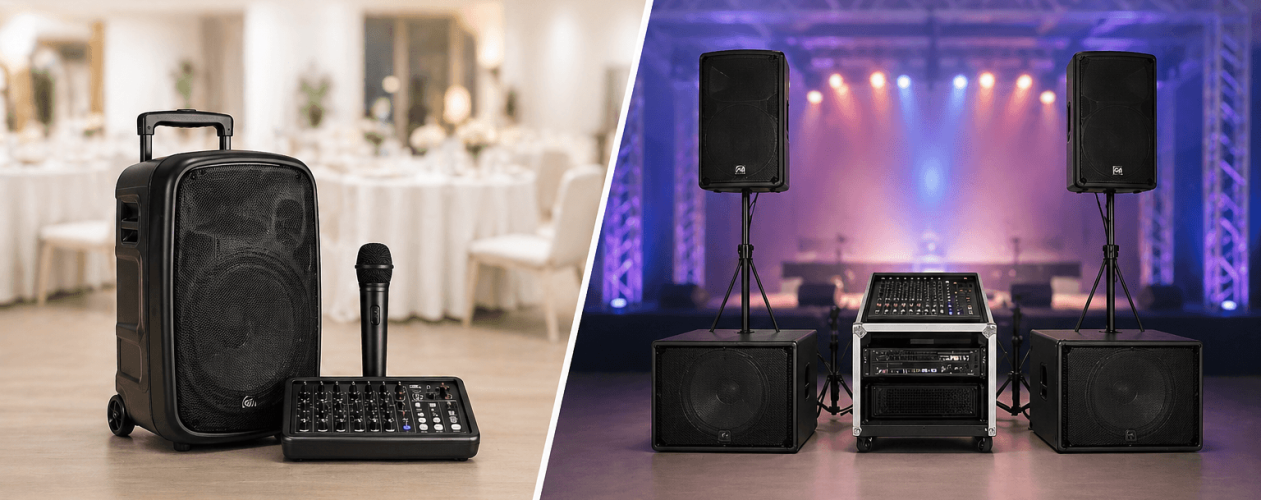
Choosing the right number of speakers for an event can seem straightforward until you actually start planning the sound system.
Is one pair of speakers enough for 100 guests? Do you need four speakers for 300 people? What happens if the event is outdoors? And does a conference for 500 people require the same PA system as a party for 500 people?
The answer is rarely based on guest numbers alone.
The right speaker setup depends on the size and shape of the venue, audience capacity, type of event, required volume, speaker specifications, positioning, acoustics and whether the event is indoors or outdoors.
A smaller number of correctly specified and positioned professional speakers can often perform considerably better than simply adding more speakers without a proper plan.
This guide explains how to calculate speaker requirements for an event and what you should consider before arranging PA system hire.
Why Getting Speaker Requirements Right Matters
A PA system has one basic job: make sure the audience can hear what they need to hear clearly.
But achieving that consistently across an entire venue requires more than making the system loud.
An incorrectly designed system can result in:
- Guests at the front experiencing excessive volume
- People at the back struggling to hear
- Poor speech intelligibility
- Feedback from microphones
- Bass being overwhelming in some areas and weak in others
- Large variations in volume around the venue
- Sound spilling unnecessarily into neighbouring areas
- Equipment being driven too hard
- An unnecessarily large and expensive PA system
The aim should therefore be appropriate and even sound coverage, rather than simply maximum volume.
Is There a Formula for How Many Speakers You Need?
There is no reliable formula such as:
100 people = two speakers
200 people = four speakers
500 people = eight speakers
Guest numbers are useful, but they are only one part of the calculation.
Consider two events with 300 attendees.
The first is a business conference inside a carpeted hotel ballroom. The PA system is primarily being used for speeches and presentations.
The second is an outdoor summer event for the same number of people with live music.
Both have 300 attendees, but their sound requirements could be completely different.
A better calculation considers several factors together.
1. Start With the Number of People Attending
Audience size gives you a useful starting point.
As a very broad planning guide:
| Audience | Typical Starting Point |
|---|---|
| Up to 50 people | Small PA / 1–2 speakers |
| 50–100 | Pair of professional PA speakers |
| 100–200 | 2–4 speakers depending on venue |
| 200–400 | Larger PA system / potentially 4+ speakers |
| 400–800 | Distributed or higher-output PA system |
| 800+ | Professionally designed event sound system |
These figures should not be treated as a specification.
A long conference hall containing 150 people, for example, may benefit from additional distributed speakers even though two high-powered speakers could technically produce enough volume.
Likewise, a compact room containing 150 guests may work very effectively with a carefully positioned pair of suitable speakers.
Audience size tells us how much space is likely to be occupied. It doesn’t tell us everything about how that space needs to be covered.
2. Measure the Audience Area, Not Just the Venue
Venue capacity can sometimes be misleading.
What really matters is the area over which you need to deliver sound.
Record the approximate:
Width × length × ceiling height
of the usable event space.
Then identify where the audience will actually be located.
For example, a venue could measure 30 metres × 20 metres, but if the audience occupies only the front 15 metres, your required coverage is very different.
Example
Suppose a conference room is:
20m long × 12m wide
and the stage is located at one end.
Your speakers must provide intelligible speech from the front row through to listeners approximately 20 metres away.
Simply increasing the volume of two speakers at the front may not be the best solution.
You may achieve better results with:
- Two appropriately specified main speakers
- Correct speaker height and angle
- Additional delay or fill speakers further into the room where necessary
This allows the audience to experience more consistent volume from front to back.
3. Consider the Shape of the Venue
Two venues with exactly the same floor area can require completely different systems.
Wide Rooms
A wide room may need additional speakers to provide adequate horizontal coverage.
Long Rooms
A long, narrow venue can sometimes benefit from delayed speakers further down the room rather than making the front speakers increasingly loud.
L-Shaped Spaces
Sound does not travel neatly around corners. Separate speaker zones may therefore be required.
Multiple Rooms
If guests move between different rooms, each area may need its own speakers and potentially individual volume control.
Venues With Columns
Large structural columns can create acoustic shadows and interfere with coverage.
This is why floor area alone should never determine speaker quantity.
4. Understand Speaker Coverage Angles
One of the most useful specifications when designing an event PA system is a speaker’s dispersion or coverage angle.
A professional loudspeaker might, for example, have a nominal coverage pattern around:
90° horizontal × 60° vertical
This describes the approximate area into which the speaker is designed to distribute sound.
It does not mean everything inside that angle will receive identical sound, but it provides an important design reference.
Imagine shining a torch into a dark room.
A narrow beam concentrates light over a smaller area.
A wider beam spreads the light across a greater area.
Loudspeakers behave differently from light, but the analogy helps explain why coverage pattern matters.
The objective is to position speakers so their useful coverage reaches the intended audience while avoiding excessive overlap.
5. Don’t Calculate Requirements From Watts Alone
One of the biggest misconceptions surrounding PA systems is that wattage tells you how loud a speaker will be.
It doesn’t.
A 1,000-watt speaker isn’t automatically twice as loud as a 500-watt speaker.
Actual acoustic output depends on several factors including:
- Speaker sensitivity
- Amplifier capability
- Driver design
- Maximum sound pressure level
- Frequency response
- Processing and limiting
- Cabinet design
A much more useful specification when assessing potential output is often maximum SPL, measured in decibels.
Even then, maximum SPL is not enough on its own because coverage and sound quality matter just as much.
This is one reason professional PA hire companies specify systems rather than simply asking customers how many watts they want.
6. Determine What the PA System Will Be Used For
This can dramatically change your requirements.
Speech and Presentations
If your event consists primarily of:
- Speeches
- Conferences
- Seminars
- Panel discussions
- Awards
- Presentations
the priority is speech intelligibility.
You need clear reproduction of the vocal frequency range and consistent coverage throughout the audience.
Extremely high volume or large subwoofers are generally not the priority.
Background Music
For networking events, exhibitions, drinks receptions and dinners, the system may mainly provide background music.
Coverage should feel even and unobtrusive.
You generally don’t want guests standing directly beside an extremely loud speaker while another area of the room is barely audible.
Multiple speakers operating at sensible levels can sometimes create a better environment than fewer speakers operating loudly.
DJs and Parties
Music-led events demand significantly more from a system.
A DJ setup may require:
- Higher-output full-range speakers
- Subwoofers
- Appropriate amplification
- Mixing equipment
- DJ monitoring
- Greater low-frequency capability
A PA suitable for speeches to 200 people is not necessarily suitable for a 200-person dance floor.
Live Music
Live bands introduce another level of complexity.
The PA may need to handle:
- Lead vocals
- Backing vocals
- Guitars
- Keyboards
- Drums
- Bass
- Playback
- Stage monitors
This requires careful system sizing, mixing and often an experienced sound engineer.
7. Indoor vs Outdoor Events
This is one of the biggest factors affecting speaker requirements.
Indoor Events
Inside a building, sound interacts with:
- Walls
- Ceilings
- Floors
- Windows
- Furniture
- People
Some sound energy is reflected back into the room.
This can help maintain perceived volume, although excessive reflection can also reduce clarity.
Outdoor Events
Outside, there are no walls or ceilings to contain the sound.
Sound energy disperses into the surrounding environment.
Wind, audience layout, surrounding buildings and noise restrictions can further affect performance.
An outdoor PA therefore often requires more careful coverage planning than an indoor system serving the same number of guests.
Simply taking an indoor system outside and increasing the volume isn’t necessarily the right approach.
8. Understand How Distance Affects Sound Level
Sound becomes quieter as you move away from a speaker.
In simplified free-field conditions, sound pressure level from a point-like source decreases by approximately 6 dB each time the distance doubles.
For example, if a certain level were measured at:
2 metres
then, under idealised free-field conditions, you could expect approximately:
- 4 metres: around 6 dB lower
- 8 metres: around another 6 dB lower
- 16 metres: around another 6 dB lower
Real venues are more complicated because reflections, speaker directivity, atmospheric conditions and other factors affect the result.
But the principle explains something important:
Making the front speakers louder is not always the answer.
If a room is particularly long, the audience near the stage could experience uncomfortable volume while guests at the rear still struggle to hear clearly.
Distributed speakers can solve this.
9. When Do You Need Delay Speakers?
Delay speakers are additional speakers positioned further into a venue to extend coverage.
They are called delay speakers because their audio signal can be electronically delayed so that it arrives in time with the sound from the main PA.
Imagine a 40-metre-long conference space.
You could attempt to cover the entire room using powerful speakers at the stage.
But this can create a large difference between the front and rear of the room.
Instead, the system might use:
Main PA → Audience → Delay speakers → Rear audience
The result can be considerably more consistent.
Delay speakers are particularly useful for:
- Long conference rooms
- Large marquees
- Outdoor events
- Large ceremonies
- Exhibition halls
- Long audience areas
10. When Do You Need Subwoofers?
Subwoofers reproduce low-frequency sound.
They are particularly useful for:
- DJs
- Dance music
- Live bands
- Concerts
- Product launches with high-impact music
- Fashion events
- Parties
They may be unnecessary for:
- Speeches
- Meetings
- Lectures
- Basic conferences
Adding subwoofers to a speech-only conference will not automatically make the PA system better.
The system should match the content.
11. Factor in Background Noise
Your PA system must be clearly audible above the ambient noise level.
Consider an office seminar compared with a warehouse event.
The seminar might take place in a quiet carpeted room.
The warehouse could contain:
- Ventilation equipment
- Machinery
- Forklifts
- People working
- Hard reflective surfaces
Even with the same audience size, the warehouse may require substantially different equipment and speaker positioning.
Outdoor events also have to compete with:
- Traffic
- Wind
- Crowds
- Nearby entertainment
- Aircraft
- General city noise
This is particularly relevant when planning PA system hire in London, where venues can be surrounded by significant ambient noise.
12. Calculate Microphone Requirements Separately
Speaker quantity is only one part of PA planning.
You should also calculate how many audio inputs you need.
For a corporate event, you might require:
- 1 lectern microphone
- 2 wireless handheld microphones
- 4 lapel microphones
- Laptop presentation audio
- Walk-in music
That already creates multiple audio sources requiring appropriate mixing and control.
A panel discussion may need a microphone for every participant plus one or more roaming audience microphones.
Plan microphone requirements at the same time as the speaker system rather than treating them as an afterthought.
Example 1: 50-Person Corporate Presentation
Imagine a presentation for approximately 50 people in a relatively compact London meeting room.
The event includes:
- One presenter
- Laptop presentation
- Background music
- Audience questions
A typical system might include:
- Two suitable powered PA speakers
- Speaker stands
- Wireless microphone
- Additional audience microphone
- Small mixer
- Laptop audio connection
The priority here is clear speech rather than extreme output.
Example 2: 150-Person Conference
Now consider a conference for 150 delegates.
The venue is larger and includes:
- Presentations
- Panel discussions
- Videos
- Audience Q&A
Requirements could include:
- Two or more appropriately specified main speakers
- Additional fill speakers depending on room dimensions
- Digital mixing desk
- Several wireless microphones
- Lectern microphone
- Laptop and presentation audio
- Technician or sound engineer
The exact speaker quantity would depend heavily on the room’s dimensions and layout.
Example 3: 300-Person Awards Dinner
An awards dinner has different requirements again.
The system may need to support:
- Host announcements
- Walk-up music
- Awards stings
- Videos
- Background music
- Entertainment
A suitable system might include:
- Multiple full-range speakers
- Additional distributed speakers
- Subwoofers where music requires them
- Digital mixing console
- Multiple wireless microphones
- Playback system
- Sound engineer
The aim is to make announcements clearly audible without making guests close to the stage uncomfortable.
Example 4: 500-Person Outdoor Event
Outdoor events require particularly careful planning.
A system may require:
- Higher-output main speakers
- Additional distributed or delay speakers
- Subwoofers for music
- Appropriate weather protection
- Mixing equipment
- Multiple microphones
- Power distribution
- Experienced audio engineers
Noise management may also become an important consideration.
This is where simply ordering “speakers for 500 people” becomes inadequate.
How Many Speakers Do I Need for 100 People?
This is one of the most common questions we hear.
For many relatively compact indoor events, two suitable professional speakers may provide sufficient coverage for around 100 people.
But that does not mean two speakers will always be correct.
You might need additional speakers if:
- The room is unusually long
- The room is very wide
- There are separate areas
- The event is outdoors
- Background noise is high
- The audience wraps around the stage
- There are physical obstructions
- The event is music-led
Think of audience numbers as a starting point rather than a specification.
How Many Speakers Do I Need for 200 People?
For approximately 200 guests, requirements begin to depend much more heavily on the venue.
A compact indoor event may still work with a high-quality pair of appropriately specified speakers.
A larger or more complicated venue could require four or more strategically positioned speakers.
For music events, subwoofers may also be necessary.
How Many Speakers Do I Need for 500 People?
At this size, professional system design becomes increasingly important.
Rather than asking only “how many speakers?”, consider:
- Required coverage distance
- Audience width
- Indoor or outdoor location
- Speech or music
- Maximum permitted sound level
- Speaker placement options
- Stage position
- Delay requirements
Large events should generally be treated as a complete sound system design rather than a speaker-count exercise.
Why More Speakers Doesn’t Always Mean Better Sound
Adding speakers without considering their interaction can actually make sound worse.
If multiple speakers cover the same audience area at different distances, listeners may hear the same signal arriving at slightly different times.
This can cause:
- Comb filtering
- Reduced clarity
- Uneven frequency response
- A confusing sense of direction
Good PA design therefore isn’t about putting speakers everywhere.
It’s about putting the right speakers in the right places.
Speaker Height Matters Too
Correct speaker height is frequently overlooked.
If speakers are placed too low, the people standing directly in front can absorb and block high-frequency sound before it reaches listeners further away.
Raising the speakers can improve coverage.
However, speakers must also be angled correctly so energy is directed towards the audience rather than ceilings or walls.
For temporary events, speakers are often installed on appropriate stands or professional mounting systems.
Safety must always be considered when positioning equipment.
Don’t Forget Power Requirements
PA systems need reliable electrical power.
A small conference system may have relatively modest requirements.
A large event involving:
- Multiple amplifiers
- Powered speakers
- Subwoofers
- Mixing equipment
- Stage equipment
- Lighting
can require much more careful power planning.
Never assume that because a venue has plug sockets, the available electrical supply is automatically suitable for the entire production.
Should You Hire a Sound Engineer?
For straightforward events, a professionally configured system may be simple enough for the organiser to operate.
For larger events, having a sound engineer can make a significant difference.
An engineer can:
- Set system levels
- Manage microphones
- Mix presenters or performers
- Prevent feedback
- Monitor sound throughout the event
- Respond quickly to technical problems
- Manage playback and cues
For conferences, awards ceremonies, live performances and larger corporate events, technical support can be just as important as the equipment itself.
Information to Give Your PA Hire Company
If you want an accurate recommendation, provide as much information as possible.
Ideally include:
- Event date
- Venue
- Indoor or outdoor
- Expected number of attendees
- Approximate room dimensions
- Stage location
- Type of event
- Speech, music or both
- Number of presenters or performers
- Microphone requirements
- Whether there is a DJ or band
- Access and setup times
- Available electrical power
- Any venue sound restrictions
Photos and venue plans can also be extremely useful.
The more information available at the planning stage, the easier it is to specify the right system.
A Simple PA System Planning Checklist
Before hiring equipment, ask yourself:
Audience
How many people are attending?
Venue
How large is the usable audience area?
Layout
Is the room wide, long, divided or unusually shaped?
Environment
Is it indoors or outdoors?
Content
Are you amplifying speech, music, a DJ, a band or a combination?
Microphones
How many presenters and performers need microphones?
Coverage
Does every part of the audience need the same programme?
Power
What electrical supply is available?
Control
Who will operate the system?
Access
When can equipment be delivered, installed and collected?
Answering these questions will provide a far more accurate specification than guest numbers alone.
Common Mistakes When Calculating Speaker Requirements
Choosing Speakers Based Only on Guest Numbers
Audience capacity doesn’t tell you the dimensions or acoustics of the venue.
Focusing Only on Wattage
Wattage is not a reliable measure of how well a PA will cover your event.
Putting Everything at the Front
Long venues may benefit from distributed or delayed speakers.
Ignoring Outdoor Conditions
Outdoor sound behaves very differently from indoor sound.
Forgetting Low Frequencies
Music events may require subwoofers as well as full-range speakers.
Hiring Too Much Equipment
Oversizing the PA can waste money and create unnecessary sound-level problems.
Hiring Too Little
An undersized system may be pushed to its limits, resulting in distortion and poor coverage.
Frequently Asked Questions
Are two speakers enough for a party?
For many small and medium-sized parties, two appropriately specified professional speakers can work well. Larger spaces, higher guest numbers and music-heavy events may require additional speakers and subwoofers.
How many speakers do I need for an outdoor event?
There is no fixed number. Outdoor requirements depend on audience size, coverage area, permitted sound levels, stage position and the type of programme being amplified.
Do I need subwoofers for a corporate event?
Not necessarily. For speeches and presentations, good full-range speakers may be sufficient. Subwoofers become more useful where music and impact are important.
Is one large speaker better than two smaller speakers?
Usually the decision should be based on coverage rather than size alone. Multiple appropriately positioned speakers can often produce more even coverage than one extremely loud source.
Can I hire additional speakers for another room?
Yes. Multi-room events can use separate speaker zones, although the exact equipment depends on how audio needs to be distributed between the spaces.
Can the same PA system be used for speeches and music?
Often yes, provided the system is specified appropriately. However, an event involving DJs or live music may require additional low-frequency capability and more powerful equipment than a speech-only event.
PA System Hire in London
There is no universal speaker calculation that works for every event.
A successful PA system is designed around coverage, audience size, venue dimensions, event type and acoustic conditions.
At PA Systems Hire, we can help specify the right audio setup for events across London, from smaller corporate presentations and conferences to larger indoor and outdoor events.
Instead of simply supplying a predetermined number of speakers, the aim should be to provide the right equipment in the right positions for your audience and venue.
If you’re unsure what size PA system you need, send us your venue, guest numbers, event type and room dimensions, and we can help determine an appropriate setup.
Get a Quote for PA System Hire in London