
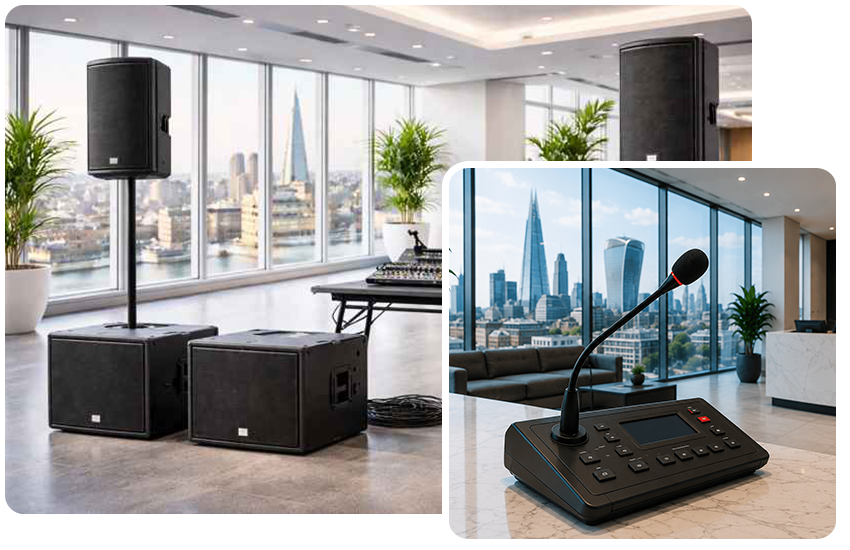
This is the question we get more than any other, and it’s usually asked the same way. “I’ve got about 150 people, what do I need?” It’s a fair question to ask, but the honest answer is that the guest count is only one part of it. We’ve set up systems for 200 person rooms that needed barely anything, and systems for 80 person rooms that needed a lot more thought than the numbers would suggest.
What actually decides the size of a PA system is a combination of things. How many people are in the room, whether you’re indoors or outdoors, what the room or space is shaped like, and just as importantly, what the system actually needs to do. Speeches need something completely different from a live band, and a live band needs something different again from a DJ playing dance music until midnight.
This guide walks through all of that properly, so that by the end you’ll have a realistic sense of what you need, and just as usefully, what you don’t.
“Size” Isn’t Really About Volume
The biggest misconception we run into is that a bigger PA system just means louder. It doesn’t, and chasing volume is usually the wrong instinct entirely.
What we’re actually balancing when we size a system is coverage. Making sure sound reaches every seat in the room at a consistent, comfortable level, against the acoustics of the space itself. A single very loud speaker pointed at 150 people will be deafening at the front and barely audible at the back. Two or three smaller speakers, positioned properly, will sound better throughout the entire room at a fraction of the volume. That’s the whole game, really. Even coverage, not raw power.
The things that actually go into the decision are the number and placement of speakers, how much power they’re putting out, whether the room (or lack of one, outdoors) needs subwoofers for low end, how many microphones are involved, and what kind of mixing desk is needed to manage it all. None of that comes down to a single number.
A Practical Guide by Guest Numbers
With that caveat firmly in place, here’s a genuinely useful starting point based on how many people you’re expecting. Treat these as a sensible baseline rather than a rulebook. Venue and event type will shift you up or down within each band.
Up to 30 guestsSmall Gatherings
Garden parties, small meetings, wedding ceremonies, fitness classes, community groups
At this size, you genuinely don’t need much. A single powered speaker, one that has the amplifier built in rather than needing a separate amp, paired with one wireless microphone covers the vast majority of what comes up here. If music matters at all, Bluetooth connectivity on the speaker is usually enough. You don’t need a dedicated mixer unless several inputs are running at once.
Typical kit: one powered speaker, one wireless mic, Bluetooth input, small mixer if needed
This is the tier where over hiring happens most often, usually because someone assumes bigger numbers mean a bigger rig regardless of guest count. For a wedding ceremony with thirty guests under a tree, a compact system that someone could genuinely set up themselves in ten minutes is the right call.
30 to 75 guestsBirthday Parties & Small Presentations
Birthday parties, school assemblies, business presentations, small conferences, charity events
This is where a second speaker starts to earn its place. One speaker covering 75 people inevitably means the back rows lose clarity, while the front rows get more volume than they want. Splitting coverage across two speakers, properly spaced and angled, fixes that without needing to push volume up at all.
Typical kit: two powered speakers on stands, wireless microphone, compact mixer
For speech led events in this bracket, assemblies, presentations, charity talks, clarity matters more than power. A decent wireless mic and two well placed speakers will outperform a single oversized speaker every time.
75 to 150 guestsWedding Receptions & Corporate Events
Wedding receptions, awards evenings, corporate presentations, networking events, hotel function rooms
This is probably the single most common booking we get, and it’s the point where a digital mixer genuinely starts to pay for itself. With speeches, background music, and possibly a first dance or a DJ set all happening across the same event, having a desk that lets you switch between inputs cleanly, rather than fumbling with cables mid event, matters more than people expect.
Typical kit: two professional speakers, digital mixer, two wireless microphones, laptop input, optional subwoofer for music
The optional subwoofer is worth a mention. For a pure speech event, an awards dinner, say, you usually don’t need one. The moment music becomes a meaningful part of the evening, especially anything with a DJ, a subwoofer transforms how the room feels. It’s the difference between music that’s technically audible and music that actually makes people want to dance.
150 to 300 guestsConferences & Larger Productions
Conferences, product launches, school productions, community festivals, indoor exhibitions
From here up, things get genuinely more involved, and this is roughly where we’d always recommend talking it through with someone rather than guessing from a guide like this one. The equipment list grows. Larger speakers, usually a subwoofer or two, a proper digital mixing desk, and often multiple wireless microphones running simultaneously for panels or presenters moving between speaking points.
Typical kit: larger speakers, one or two subwoofers, digital mixing desk, multiple wireless mics, stage monitors for presenters
Stage monitors come up a lot at this size. If you’ve got presenters or performers on a raised stage, they often need to hear themselves separately from what’s being sent to the audience, what’s known as foldback. It’s an easy thing to forget about until someone’s standing on stage unable to hear their own voice properly.
300 to 500 guestsLarge Scale Events
Large conferences, sizeable festivals, big wedding receptions, major product launches
At this point, the venue itself becomes just as important as the headcount. A 400 person marquee and a 400 person conference hall are completely different acoustic problems, and the equipment needed to cover them properly reflects that.
Typical kit: four or more speakers, dedicated subwoofers, digital mixing console, wireless microphone system, delay speakers where required, an audio technician
Delay speakers are worth explaining, because they trip people up. In a long room, sound from the main speakers takes a fraction of a second to reach the back. Delay speakers, positioned further back and electronically timed to match that delay, make the sound feel like it’s coming from nearby rather than echoing in from the front. It’s a subtle fix, but it’s the difference between a room that sounds professional and one that sounds like a stadium tannoy.
This is also the size where having someone running the system throughout the event, rather than setting it and leaving it, genuinely changes the outcome. Rooms fill up, acoustics shift, and someone needs to be adjusting for that in real time.
500+ guestsFestivals, Concerts & Major Public Events
Outdoor festivals, sporting events, large conferences, public celebrations, concerts
This is proper production territory, and it’s not something to plan from a blog post. This tier needs a system designed specifically for the venue, ideally by someone who’s walked the site. Line array speakers, tall, vertically stacked speaker columns designed to throw sound evenly over long distances, typically replace standard speaker boxes at this scale, alongside multiple subwoofers and often delay towers positioned throughout the crowd.
Typical kit: line array speakers, multiple subwoofers, digital mixing desks, stage monitors, wireless mic systems, delay towers, an experienced sound engineer on site throughout
An experienced engineer isn’t optional here. It’s a structural part of the system working at all. With this much equipment running simultaneously, someone has to be actively managing levels, watching for feedback, and adjusting for a crowd that’s constantly changing the room’s acoustics just by being there.
Indoors and Outdoors Are Not the Same Job
One thing that catches people out constantly is assuming a system that works well indoors will work the same way outside. It won’t, and the reason is straightforward physics rather than anything mysterious.
Indoors
Walls and ceilings reflect sound back into the room, which actually helps. It means you generally need less power to fill the space. The trade off is that very hard, reflective rooms, think marble floors, glass walls, high ceilings, can create echo and muddiness, so placement matters more than power.
Outdoors
There’s nothing to bounce sound back, so it just dissipates into open air. That means outdoor events typically need more powerful speakers, more of them, bigger subwoofers for any bass to register at all, and weatherproofing. If there’s no mains power on site, you’ll need a generator too.
This is exactly why two events with identical guest numbers can need completely different rigs. A 200 person wedding reception in a marquee and a 200 person reception in a hotel ballroom are not the same job, even though the number on the guest list is identical.
What’s Actually Happening Matters as Much as Headcount
The other variable that gets overlooked is what the system is actually being used for. Speech, music playback, and live performance all place very different demands on a PA system, even at identical guest numbers.
For speech only events, conferences, ceremonies, presentations, clarity is everything, and a relatively modest system with good microphones will often outperform a much larger one that wasn’t designed with intelligibility in mind. Music playback is a different challenge entirely. It needs a wider frequency range, and a subwoofer to handle the bass properly, since dance floor music in particular falls apart without low end. Live performances raise the bar further still. Bands typically need a bigger mixing desk, monitor speakers so performers can hear themselves, multiple microphones, DI boxes for instruments plugging in directly, and usually an engineer who can ride the mix as the performance unfolds.
Two events with the same number of guests, the same venue, and the same date can need genuinely different systems purely because one has a live four piece band and the other has a laptop playing a Spotify playlist. Don’t assume guest count alone tells you what you need.
The Room Itself Changes Everything
We’ve touched on this already, but it’s worth saying plainly. Two venues holding the same number of people can require completely different equipment. Ceiling height, the shape of the room, pillars or other obstructions, whether there’s a balcony pulling some of the audience further from the stage, how the audience is actually distributed around the space, and where the stage or focal point sits all change the calculation.
This is really the core reason a proper hire company should always want to know about your venue before quoting, not just your guest count. A number on its own doesn’t tell you much.
Where People Go Wrong
A few mistakes come up again and again, and most of them are avoidable with a bit of forethought.
01
Choosing equipment purely on wattage
A higher wattage number doesn’t automatically mean better coverage. Placement and speaker design matter far more than the figure printed on the spec sheet.
02
Assuming one speaker will do the job
Even at modest guest numbers, a single speaker almost always creates an uneven listening experience, loud at the front, weak at the back.
03
Not accounting for outdoor sound loss
Booking an indoor spec system for an outdoor event is one of the most common reasons people end up disappointed with how their event sounded.
04
Forgetting about microphones until the last minute
Speakers get all the attention in the planning stage, but if your event has speeches, the right number and type of microphones matters just as much.
05
Ignoring the venue’s acoustics entirely
A hard floored, high ceilinged hall behaves nothing like a carpeted conference room with soft furnishings, even at the same guest count.
06
Trying to save money by under hiring
The cheapest system isn’t good value if half the room can’t hear properly. It’s worth spending slightly more to get coverage right than to save a little and have guests straining to follow speeches.
If You’re Still Not Sure
None of this requires you to become an audio expert before you call someone. Genuinely, you don’t need to know what a DI box is, or how many subwoofers your marquee needs. What’s actually useful to have ready when you get in touch is your venue, roughly how many guests you’re expecting, whether you’re indoors or outdoors, whether it’s mostly speech or mostly music, and how long the event runs for.
Give us those five things and we can recommend a system that’s actually right for your event. Not the biggest package we have sitting in the warehouse, and not something underpowered that’ll leave half the room unable to hear the best man’s speech.
The right PA system was never about being the biggest or the most expensive. It’s the one that’s properly matched to your event, your venue, your guest count, and what you actually need it to do. Get that right, and people simply hear what they’re meant to hear, presenters feel confident, and the audio becomes invisible, which, honestly, is exactly what you want from it.