
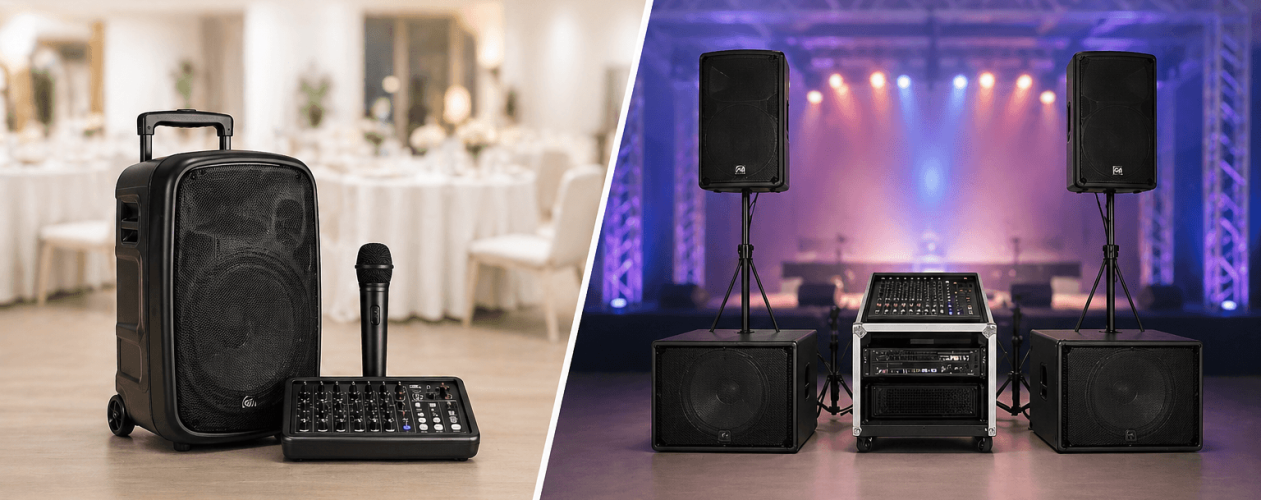
When people first start looking into PA hire, they often assume the kit is the kit. A speaker is a speaker. You plug it in, it works. But the environment your event is in changes almost everything about how a sound system needs to be designed and set up.
Indoor and outdoor events are genuinely different jobs. This post explains why, so you know what to expect and what questions to ask when you’re booking.
The core difference: sound behaves differently outside
Inside a room, sound bounces off walls, floors and ceilings. That’s not always a bad thing. Those reflections help fill a space. A well-designed indoor system works with the room’s natural acoustics to deliver even, consistent sound without needing massive power.
Outside, there are no walls. Sound disperses in every direction and disappears into open air. There’s nothing to bounce off and nothing to contain it. To get the same level of clarity and coverage outdoors that you’d get in a conference room, you need considerably more power and a smarter speaker layout.
Indoors
Working with the room
Walls and ceilings reflect and contain sound. You need less raw power but more careful placement to avoid echo and feedback. The challenge is consistency across different parts of the room.
Outdoors
Fighting open air
Sound disperses fast with nothing to contain it. You need more power, weatherproof equipment, and careful coverage planning to reach the far end of a site without blasting the front rows.
How the equipment changes
Power and speaker size
Outdoor events typically need more powerful speakers than you’d use for an equivalent indoor event. For a garden party or outdoor corporate reception with 100 guests, you’d likely need a system that would be overkill for the same number of people in a conference room. The open air just eats volume.
Speaker placement and coverage
Indoors, a well-placed pair of speakers can often cover a room cleanly. Outdoors, you usually need to think more carefully about coverage zones. A large outdoor event might use delay speakers positioned through the crowd so everyone gets clear sound without the front section being deafened.
Weather protection
This is the obvious one but it matters. Equipment used outdoors needs to be weatherproof or properly protected. In the UK, that’s not optional. Even a dry day can turn quickly. Cables, connections and speaker housings all need to be suited to an outdoor environment.
Power supply
Indoor venues almost always have sufficient power supply close to where you need it. Outdoors, especially in parks, fields or marquee setups, you might be running from a generator or a distant power source. Cable runs are longer, which has implications for setup time and safety.
How the two environments compare across key factors
Indoor vs Outdoor: at a glance
IndoorPower needed
OutdoorPower needed
Moderate. Rooms contain and amplify sound naturally.
High. Open air disperses sound rapidly in all directions.
IndoorMain challenge
OutdoorMain challenge
Echo, reflections and feedback from hard surfaces.
Coverage, volume loss and weather protection.
IndoorSpeaker placement
OutdoorSpeaker placement
Fewer speakers needed, positioned at the front or sides.
More speakers often required, sometimes spread through the site.
IndoorSetup time
OutdoorSetup time
Shorter. Power and access are straightforward.
Longer. Cable runs, generator setup and weather checks add time.
IndoorWeather
OutdoorWeather
Not a factor.
A serious consideration. Equipment must be weatherproof or covered.
What about venues that are somewhere in between?
Not every event fits neatly into indoor or outdoor. Marquees are a good example. They’re technically sheltered but acoustically they behave quite differently to a hard-walled room. Fabric absorbs some sound but doesn’t reflect it the way brick and plaster do. Marquee setups often need more coverage than you’d expect for the footprint.
Partly covered outdoor spaces like festival stages with canopies, courtyards, or venues with one open side are similar. Each one is a bit different and worth discussing when you book.
One thing people often underestimate: the time needed to set up outdoor PA properly. If your event starts at 2pm, we’d typically want access to the site by late morning at the latest for a larger outdoor setup. This is worth factoring in when you’re talking to your venue about access times.
Does outdoor PA cost more?
Generally, yes. Not always dramatically, but the combination of more powerful equipment, longer setup times, and the need for weatherproofing usually means outdoor hire comes in at a higher price than an equivalent indoor job. If your event is outdoors and you’re comparing quotes, make sure you’re comparing like for like.
What to tell us when you enquire
The more detail you can give us about your venue and setup, the more accurate a quote we can give you. The things that help most are whether the event is indoors, outdoors or in a marquee, how many people you’re expecting, whether there are any power supply constraints at the venue, and what time you have access for setup.
We’ve worked at venues and sites across London and the surrounding area for over ten years. If you describe the setup to us, we’ll tell you honestly what you need and what it’ll cost.